


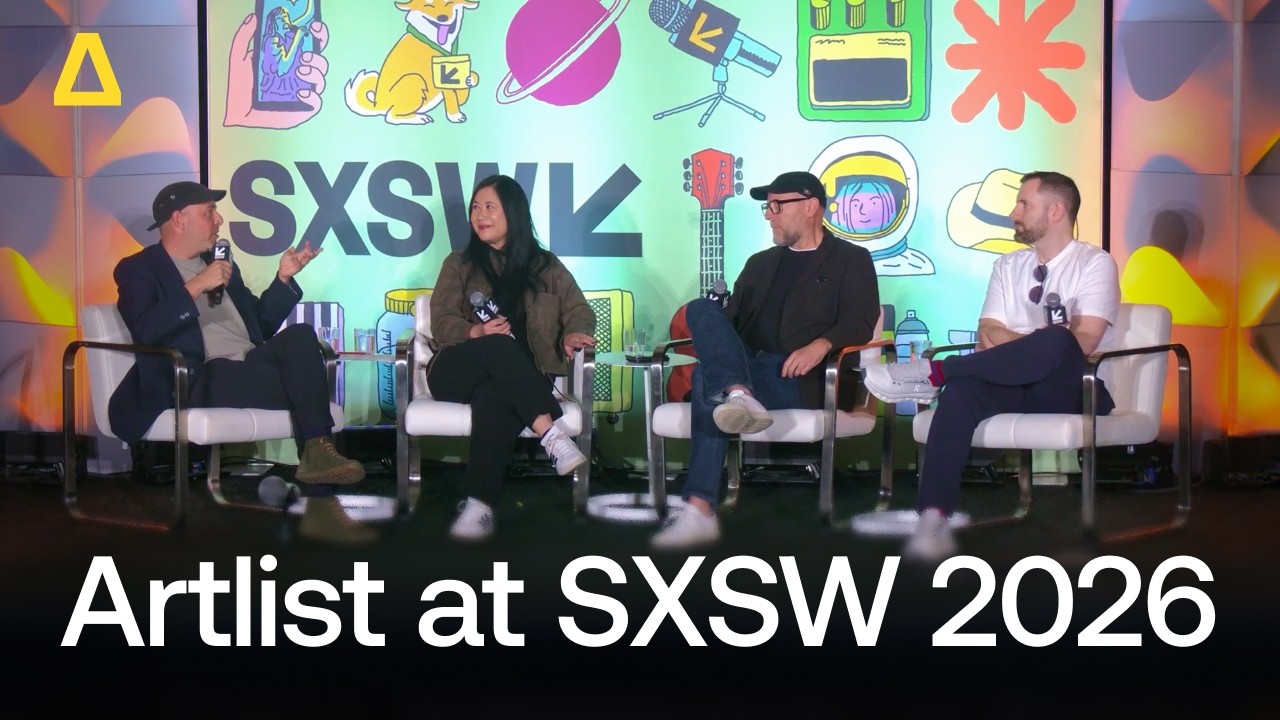
There’s a version of the AI conversation that sounds like a threat — shrinking crews, replaced jobs and a flood of AI slop diluting human voices. What happened on stage at SXSW 2026, hosted by Artlist, felt less like a warning and a lot more like a green light.
For the past two years, the film industry has been operating on a kind of “don’t ask, don’t tell” basis, being curious about AI behind closed doors but cautious in public. This panel was the antidote to that. Three of the industry’s sharpest minds pulled back the curtain on how professionals are already using AI to amplify human creativity, not replace it.
Moderated by Artlist’s Head of Music and Sound, Ori Winokur, the panel included:
- Christina Lee Storm, Head of Studio Narrative at Secret Level, whose career spans DreamWorks Animation, Netflix, and founding PLAYBOOK, spoke with the confidence of someone already working inside this shift.
- Chad Nelson, Creative Specialist at OpenAI, brought a perspective shaped by experimenting with AI tools before most of the industry caught on.
- Joshua Davies, Chief Innovation Officer at Artlist, who has spent two decades building tools for filmmakers, grounded the conversation in what creators actually need day to day.
The creative, the technical, and the industry — and a surprisingly unified message about where things are heading.
“AI isn’t here to replace our jobs as creators”
Ori set the tone early, framing the session around a question the industry has been circling for two years: not whether AI will become part of the creative workflow, “I think it already is,” but how creators choose to shape it.
For many in the room, that question still carries a level of uncertainty. But on stage, the perspective was far more grounded. Josh put it simply:
“AI requires the creative. It does not get on and do things without the creative.”
That idea became the foundation for everything that followed. Christina has consistently bridged traditional production with emerging technologies, and in her current role as Head of Narrative Studio at Secret Level, one of the leading AI-native studios working today, she’s doing exactly that. Far from feeling threatened, she’s energized by what’s opening up
“I think it’s an amazing time for filmmakers to think about a story they’ve always wanted to tell. Your stories are really important, and you’ll have an opportunity to tell them where we really didn’t have that opportunity when I was starting out.”
Chad, who in 2022 was among the first 30 people to have access to DALL-E 2, has watched the studio conversation shift dramatically in just three years. In 2023, AI couldn’t even be mentioned at industry events. By 2026, it had become the entire agenda.
“It’s definitely shifted within the industry. Studios are now talking about it, wanting to learn, and curious to see how it can fit into their current workflows.”
The control problem and how it’s solved
If there was one theme that ran through the conversation, it was control, the gap between what AI can generate and what a professional creator actually needs.
Josh framed it through the lens of Artlist’s creators, who come from traditional filmmaking backgrounds and have a precise vision for what they’re making. Filmmakers don’t want to be prompt engineers; they want to be directors.
Prompting text into a void isn’t their language. “A cinematographer wants to move the camera by three inches — not describe that by writing it in. They want to change a light that’s one foot up. They have no way of expressing this through AI.”
What’s coming, Josh declared, is an application layer built on top of the models that gives creators the kind of tactile, precise control they’d expect from any professional tool. Not prompting, but directing. Not generating, but producing.
“The people making the most amazing things with AI right now are creators who have an understanding of all the traditional elements of filmmaking.”
2026 is the year for making
Ori described 2025 as “the year of wonder”, a moment defined by the sheer novelty of generative AI. The ability to create something from nothing.
But 2026 feels different. It’s less about what’s possible and more about what’s practical.
The panel was clear about the limitations. Chad offered a vivid benchmark for what hard looks like right now: a Thanksgiving dinner table. Twelve people with overlapping dialogue, action, a dog under the table, and food being passed around. Realistic, simultaneous, directed.
“We still can’t do that with an AI tool. It just gets muddy almost instantly. Maybe I could throw hundreds of generations at it and get lucky a few times, but we’re just not there yet.”
But the direction it’s headed is exciting. Josh noted that just a year ago, eight seconds of coherent footage felt like a ceiling. Now it’s fifteen. Tools like Kling 3.0 Motion Control, available inside the AI Toolkit, are already pushing what’s possible, maintaining visual consistency across angles, camera directions, and longer sequences. The Thanksgiving table isn’t a question of if. It’s when.
A new kind of circular workflow
The circular workflow Ori described captures something fundamental about what AI is doing to the production process. Traditionally, filmmaking has been linear: script, pre-production, production, post. Each stage builds on the last, with almost no way to go back.
AI breaks that sequence entirely. Ideas can be visualized before they’re fully written. Scenes can be generated and refined before anything is shot. The distance between idea and execution doesn’t have to be measured in weeks and budgets anymore; it’s nearly instant.
Christina described a new kind of animatic workflow already emerging from this: teams seeing their film at near-final quality before a single camera rolls, having the right creative conversation at exactly the right moment instead of discovering problems in post.
The process becomes more about exploration, which is both the opportunity and, as Chad noted, the new creative discipline. When everything can be changed at any point, someone still has to decide when it’s right.
The music industry is proof
One of the most grounding moments in the conversation came when Ori drew a parallel to another creative industry that has already gone through a similar transformation.
When digital production tools became widely accessible in music, the barrier to entry collapsed. Bedroom producers started creating Grammy-level work that rivalled professional studios. New stars emerged from nowhere. The major labels didn’t disappear; they adapted, learning when and how to find talent that was already building audiences independently. The infrastructure changed, but the craft didn’t.
Ori sees the same shift coming for film, and the numbers back it up. Artlist’s platform is trusted by over 50 million creators worldwide, a community already using AI tools to make things that simply weren’t possible before.
But the conversation that followed was as much about what AI can’t replace as what it can generate. Chad shared that during production of the feature-length version of his early DALL-E 2 short Critters, the longest part of the process by far was locking the script, which took six months.

“Crafting a really good story that’s worth watching, that emotionally hits me and speaks to volumes of people, that’s still hard work. And it will still take a team.”
Christina agreed and pushed the point home: “The need for fantastic writers and screenwriters is more important than ever. That’s not changing.”
Three years from now
Looking ahead, Christina pointed to the thing she’s most excited about, what she sees as a coming renaissance of independent filmmaking — smaller teams with greater creative reach and more stories finally getting made.
Josh was precise about the technical progression: moving from generating individual shots to fully realized scenes, with consistent characters, dialogue, and direction. And beyond that: agentic tools that understand the full scope of your project, that know what shot you’re working on because they’ve read your script, maintain continuity, and act as part of the creative process itself.
“Three years from now, I think we’ll hit that Thanksgiving table. And the creators using these tools today are going to be so much closer to the big screen, so much closer to actually telling the story they want to tell.”
Chad’s answer pointed to the next creative frontier: not making content, but getting it seen. As production costs fall and the speed at which content can be made increases, volume explodes. We’re moving toward a world of infinite content, but not infinite attention. Discovery becomes the challenge. But his underlying message was optimistic, excited for more voices, more stories, more genuine creative ambition finding its way into the world. And summarized by Ori:
“There’s only ten places at any top ten chart.” The traditional industry is still going to have a very important role in surfacing what matters.


The best time to be a creator
At the end of the session, there was a palpable energy in the room, excitement for what’s coming, and curiosity about what’s possible. As Josh put it simply: “Without AI, I’d be losing a superpower. With it, I can see things that exist only in my head come to life.”
That’s the promise of Artlist Studio and the AI Toolkit, providing creators with the tools to finally execute work at the highest level. End-to-end production in one place powered by the world’s best AI models. A platform built by people who create every day, for people who create every day.
Christina’s final words summed it up perfectly. “This is your time to lean in and have agency. Get educated, learn, and decide if you want to do that professionally. Story is always going to be king, or queen.”
The tools are ready. What are you making first? AI doesn’t decide what to make. Creators do.
Artlist was the creative AI partner of South by Southwest 2026. Create anything you can imagine with the Artlist AI Toolkit and Artlist Studio, coming soon.
Did you find this article useful?


